Today I noticed something interesting on the way home. I was riding the bus, looking up at the display (an LCD) which normally shows the time of day and various information about where we were five minutes ago. The display is made up of fifteen or so panels, each of which displays one letter or digit. As usual, the displayed time was off by an hour or so, but that’s not what interested me. No, the weird thing was that one of the panels was nearly black, while the rest were a sort of cheery orange-yellow color.
I stared at it for a bit, and noticed that as my head moved around the appearance of the panel changed. Eventually I discovered that if I looked directly through my sunglasses, the panel was black, but if I looked over the top of the glasses, it looked just like the others. Tilting my head left and right as I looked through the sunglasses yielded various intermediate colors, and putting the glasses frame right over the panel gave it a sort of split effect.
A bit of physics
It turns out that LCDs are polarized, as are my sunglasses. Briefly, polarizing filters block (or pass) light based on how the squiggles of each light wave are oriented: if the light is oriented on the same axis as the filter, it gets through, otherwise it doesn’t. Actually, somewhere between all and none of the light gets through, depending on how close the orientations of wave and filter are. Here’s a picture to help visualize it, showing unpolarized light passing through a vertically-oriented polarizing filter:
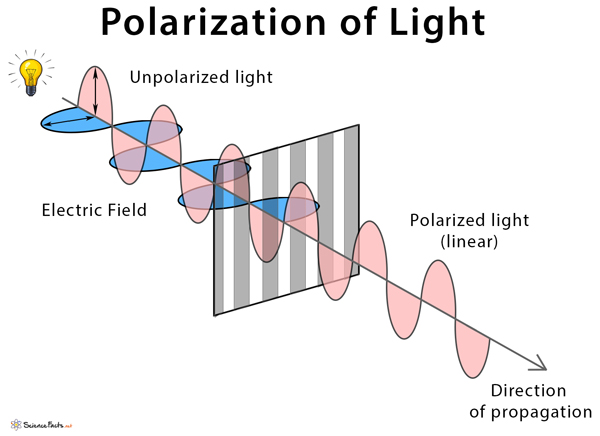
(click the image to read the entire article)
As you can see, only the vertical “component” of the wave makes it past the filter.
Normal ambient light, from the sun and most typical light sources, is composed of zillions of light waves, all with different polarization. This means that if you put on a pair of polarized sunglasses, things look a bit darker, because some of those waves have been blocked, but things look more or less like they did before. The interesting effects show up when the light hitting your sunglasses is already polarized for some reason, like the light coming out of the LCD on the bus. Apparently most of the panels on the display were polarized in approximately the same direction as my glasses were, but that one weird panel was close to 90 degrees different, so that together they filtered out almost everything. Another place you’ll notice this is car windshields, which often take on an odd bubbled-rippled-rainbowy look, because of how they’re pressure-treated at the factory.
Anyway, I highly recommend getting yourself some of these sunglasses, and then wandering around to see what you notice. As a bonus, they also work really well for their intended use, namely making it easier to see in bright light.
A bit of politics
As I sat there and tilted my head around like a goof, watching how the LCD panel got lighter and darker, I got to thinking about a more common use of the word “polarize”, namely https://en.wiktionary.org/wiki/polarize: “To cause a group to be divided into extremes”. I was particularly thinking about how, in my eyes, that LCD looked totally different than it did to the rest of the people on the bus. They saw a normal time display, and I saw “6:1▮ PM”. Whose view was the right one? In this case, it’s pretty clear that I was in the minority, but it sure looked weird to me.
It’s even more interesting when you consider the broader picture, with a hotly-contested presidential election on the horizon and an economy staggering toward the unknown. Political and economic polarization are as strong now as they ever have been, and I can’t help but wonder if our own mental filters make it really hard for us to see the world clearly. I know how the world looks to me, but that’s just one perspective: that of a middle-class Democrat with (I hope) a secure job. The problem with biases (and polarized sunglasses) is that it’s really easy to forget they’re there. Am I missing something really important because I’m so focused on getting a Democrat into the White House? Have some Republicans been partially blinded by their heartfelt conviction that we have to win before we can leave Iraq?
I don’t know, but it’s worth thinking about.